
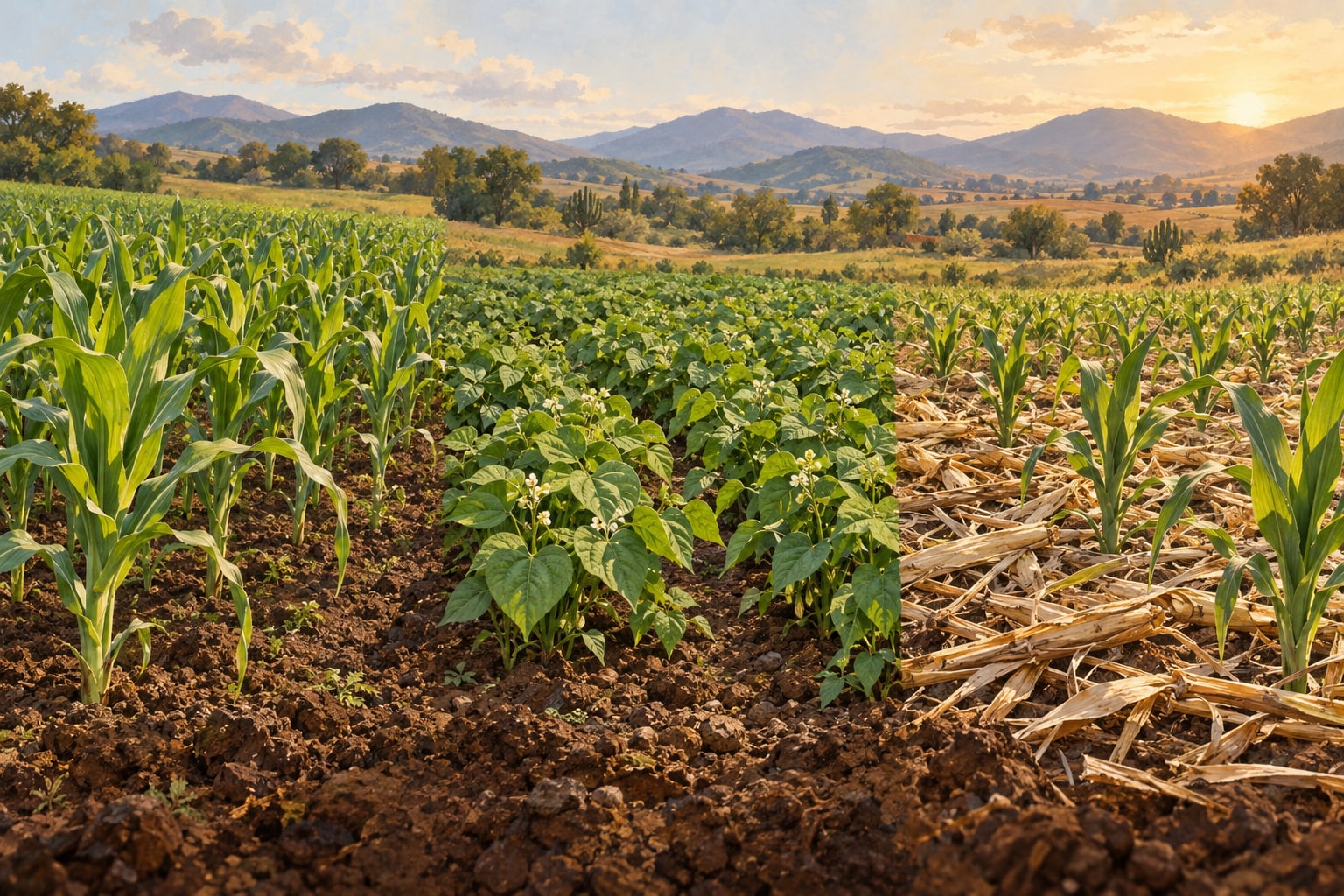
Change begins beneath the harvest
A field receives much more than seeds at the start of a growing season. It also inherits the consequences of the previous crop: roots, residues, depleted nutrients, weeds, and organisms capable of affecting the next harvest. Crop rotation uses this continuity to organize a sequence of crops with complementary functions.
Rotation means growing different crops on the same land over time. A season of maize followed by beans and then maize again constitutes a rotation. Growing both crops simultaneously is intercropping, although the two practices can be combined within a diversified system.
Crop rotation should also be distinguished from cover cropping, in which plants are grown mainly to protect the soil or provide agronomic services, and from green manuring, in which plant biomass is returned to the soil, usually through incorporation. A cash crop rotation can include either practice between harvests. The intended function determines the management approach and the expected outcome [1] [2].
From an idea to a working field
In an illustrative example, a farmer who continuously grows maize decides to test beans for one season before returning to the cereal. The new sequence changes crop residues, the timing of field operations, and opportunities for certain organisms to reproduce. It also produces a different harvest that requires buyers, equipment, and its own budget.
Another field might retain its main crop and introduce a cover crop during an available growing window. The additional plants would need to establish, fulfill their purpose, and be terminated before interfering with the next planting. A period without a cash crop does not necessarily provide suitable conditions: moisture, warmth, or time may be insufficient.
Research supports this approach, with important limits. Zhao and colleagues analyzed 11,768 paired observations from 462 experiments and found that crops following legumes yielded an average of 20.4% more than those following nonlegume crops. However, 25.7% of the observations were negative. The average demonstrates potential but does not predict the response of every field [1].
Nitrogen does not appear by magic
Legumes can associate with bacteria that form nodules and fix atmospheric nitrogen. Plants use that nitrogen to grow and produce tissues. The benefit to the following crop depends on how much nitrogen was fixed, how much remains in roots and residues, and how much leaves the field at harvest.
A legume grown for grain therefore does not necessarily make the same contribution as one returned to the soil as green manure. Its ability to fix nitrogen does not eliminate the need for other nutrients. Soil fertility, the bacterial association, and growing conditions influence the outcome [3].
Nitrogen contained in plant biomass must be transformed before the next crop can use it. Decomposition can release it gradually, while carbon-rich residues may cause temporary immobilization: microorganisms take nitrogen from the soil to break down the material. Temperature, moisture, and residue composition influence the rate of release [4].
Different roots, different challenges
Plants explore the soil through different root architectures. Some produce extensive networks of fine roots; others develop vigorous taproots. Their residues and biological activity can contribute to soil structure and protection. These effects require sustained management and do not guarantee that every compacted layer will be corrected [2].
Rotation can also interrupt disease cycles when it introduces a crop that prevents the problem organism from reproducing. However, changing the crop's name or botanical family is not enough. The fungus Sclerotinia sclerotiorum, for example, has numerous hosts and persistent survival structures; alternating susceptible crops can maintain the problem. Weeds that serve as hosts also matter [5].
Diversifying the farming calendar changes opportunities for weed establishment and control as well. In Iowa, Davis and colleagues found that systems with more diverse rotations maintained productivity and profitability with fewer synthetic inputs. Those systems included forage legumes, manure, and other adjustments: the results reflected the entire system, rather than the crop change alone [6].
Sesbania: a promising partner with strings attached
Sesbania encompasses several species, making seed identification essential. Sesbania rostrata stands out for forming nodules on roots and stems through its association with Azorhizobium caulinodans. This characteristic helps explain the interest in using it as green manure in tropical rice systems [7] [8].
An experiment by Rinaudo and colleagues, conducted in irrigated microplots in Senegal with phosphorus and potassium, showed a substantial rice response after incorporation of this legume. The scale and conditions of the trial prevent the result from being treated as a promise of commercial yields [7].
The Senegal experiment incorporated Sesbania rostrata after 52 days of growth. This was a trial condition rather than a universal calendar: local decisions should consider plant development, climate, residue decomposition and the rice planting date [7].
Profitability is not assured either. A study by Becker and colleagues in the Philippines found that, in the wet season and at the labor and fertilizer prices used in the study, green manure grown before rice was less economically attractive than mineral nitrogen fertilizer. In the dry season, relay cropping offered better returns. Sesbania must justify both its agronomic contribution and the time and resources it occupies [9].
The best crop is the one that does the job
Selection begins with the dominant problem. Where nitrogen supply is the priority, well-adapted legumes with effective bacterial associations are candidates. Where the goal is to capture residual nutrients or produce protective residues, cereals such as oats and cereal rye can be useful. Their effects on the following crop depend on maturity and management [2].
During warm growing windows, cowpea and Crotalaria juncea offer possibilities for ground cover and biomass production. During cooler seasons, Vicia villosa, certain clovers, and field peas provide alternatives. Seed availability and local adaptation influence every choice; calendars from a foreign guide cannot replace regional trials [10].
Mucuna pruriens has been evaluated in Mexican tropical farming systems [11]. A forage phase may also fit where livestock can use the crop or a market exists, as illustrated by the rotations studied in Iowa [6]. Candidates should be compared according to their function and the value of the complete sequence.
Mixtures require an additional decision: the balance of functions being sought. A grass can capture nutrients and provide lasting residues while a legume supplies nitrogen, but a dominant species can reduce the other's contribution. As an evaluation criterion, the composition actually achieved deserves more attention than the number of species listed on the seed bag. The mixture should justify its cost and make subsequent management practical.
When a cover crop drinks the next harvest's water
A living plant uses water. After termination, its residues can reduce evaporation, but those savings do not necessarily compensate for water consumed during growth. This trade-off is particularly important in rainfed agriculture and dry environments.
Garba, Bell, and Williams analyzed cover crops replacing fallow periods in dryland systems. They found average reductions of 7% in subsequent crop yield, 18% in soil water, and 25% in mineral nitrogen at planting. Results varied with conditions and management; they do not describe every cash crop rotation [12].
Maximum biomass therefore does not always represent the best outcome. Earlier termination can conserve water, although it reduces residue production. A cover crop should be evaluated by what it delivers to the next crop and what it consumes to provide those benefits.
Successes and setbacks that change the decision
Mexican experience shows that yield and profitability can move in different directions. Saldivia-Tejeda and colleagues evaluated systems in Querétaro through two experiments and work on 17 farmers' fields. Responses varied among locations; maize–bean rotation was economically attractive because of the value of beans, although it did not always produce the highest maize yield. In Cadereyta, all treatments had negative net profits, although maize–bean rotation reduced the loss. Treatments combined rotation, permanent beds and crop residues; the results do not isolate the effect of rotation [13].
In Los Tuxtlas, Veracruz, Eilittä and colleagues found increases of 45–58% in second-season maize yield under some treatments that included mucuna. In absolute terms, those increases amounted to only 0.15–0.23 additional metric tonnes per hectare. The authors cautioned that they might not compensate for labor or displaced production [11].
An applied research report from Texas A&M and SARE documented failed establishment caused by insufficient rainfall and mixtures dominated by cereal rye. Although it is not equivalent to a peer-reviewed article, the report shows how seasonal adaptation and seeding proportions can determine actual performance [14].
The process starts with a field diagnosis
An organized implementation begins by collecting records of crops, yields, costs, weeds, and diseases. Soil testing helps identify limitations involving texture, pH, salinity, organic matter, and nutrients. When disease management is the objective, identifying the organism is decisive for selecting a suitable alternative [2] [5].
A measurable objective is then established: maintaining yield with less fertilizer, reducing a particular weed, or increasing annual profit. SARE recommends focusing selection on a few priorities and building a calendar that includes planting, harvests, rainfall, and labor availability [15].
As a proposed approach to implementation, an initial evaluation can compare the usual management system, one candidate species, and a simple mixture in replicated strips. Keeping other factors comparable makes the effect easier to interpret. If tillage and fertilization also change, the evaluation will describe the complete management package.
From seed to residue: every step counts
Before planting, species identity, seed quality, the appropriate inoculant where needed, and compatibility with previous management are checked. Residual herbicides can limit the options. The termination method and the next planting operation should also be planned; applied research has documented these challenges [14].
During growth, emergence, ground cover, weeds, and nodulation are monitored. In mixtures, the dominant species should be identified. Termination decisions consider remaining moisture, biomass, growth stage, and the cash crop calendar, while also confirming that the chosen method stops further growth [2] [14].
Nutrient estimates require measurements of dry matter and nitrogen concentration. A hypothetical example of 4,000 kilograms of dry matter per hectare containing 2.5% nitrogen holds 100 kilograms of N. That amount does not automatically equal atmospheric nitrogen fixation or replaceable fertilizer nitrogen. Availability depends on decomposition and losses [4].
Starting in Mexico, adapting anywhere
The following approaches are proposals derived from the evidence and remain subject to local validation. In Mexico, a cash crop legume can provide a starting point where a market and suitable growing conditions exist, as suggested by the maize–bean case in Querétaro. In tropical environments, mucuna or Sesbania merit evaluation according to the main crop and the available growing window [11] [13].
Under rainfed conditions with limited moisture, introducing a cover crop during the dry season requires particular care. Rotating crops between seasons can offer a different option from adding an intermediate crop. Under irrigation, the budget should include water, energy, and any harvests that may be displaced [9] [12].
Outside Mexico, the same logic applies: diagnosis, regional adaptation, a measurable objective, and a comparative trial. International evidence supplies candidates and mechanisms; each farmer needs to confirm that they work with local rainfall, soil, buyers, and operational capacity.
A rotation must earn its place in the budget
Monitoring connects functions with outcomes: establishment, biomass, soil water before the next planting, nutrient availability, disease and pest problems, yield, and quality. It also records seed, equipment, labor, irrigation, and marketing costs. Observing several cycles helps distinguish a persistent response from an exceptional year.
The economic calculation considers additional revenue and avoided costs, minus new costs and the margin lost from displaced harvests. Reduced fertilizer use does not demonstrate profitability if it requires more expensive operations. Likewise, a large percentage increase in yield may deliver few additional tonnes, as occurred in Los Tuxtlas [11].
In a purely illustrative example, a cover crop that costs MXN 3,500 per hectare and saves MXN 2,000 in fertilizer needs other measurable benefits to break even during that cycle. If yield remains unchanged, there is a difference of MXN 1,500. This example does not represent current prices or an estimate for a specific crop; it shows why savings on one input must be compared with the full investment.
Crop rotation delivers value when each phase creates useful conditions for the next and supports an economically viable sequence. Implementation requires measurement, adjustment, and retention of the alternatives that address the field's actual limitations.
Sources and references
Implementation suggestions require local validation. Nitrogen and cost examples are hypothetical. Documentary review: October 5, 2026.
- Zhao, J., et al. (2022). Global systematic review with meta-analysis reveals yield advantage of legume-based rotations and its drivers. Nature Communications, 13, 4926.
- Sustainable Agriculture Research and Education (SARE). Building Soils for Better Crops: Chapter 10, Cover Crops. Institutional technical guide.
- van Kessel, C., and Hartley, C. (2000). Agricultural management of grain legumes: has it led to an increase in nitrogen fixation? Field Crops Research, 65(2–3), 165–181.
- University of Georgia Extension. Predicting Nitrogen Release from Cover Crops: the Cover Crop Nitrogen Availability Calculator. Bulletin 1466. Institutional technical documentation.
- O’Sullivan, C. A., et al. (2021). Tackling Control of a Cosmopolitan Phytopathogen: Sclerotinia. Frontiers in Plant Science, 12, 707509.
- Davis, A. S., Hill, J. D., Chase, C. A., Johanns, A. M., and Liebman, M. (2012). Increasing Cropping System Diversity Balances Productivity, Profitability and Environmental Health. PLOS ONE, 7(10), e47149.
- Rinaudo, G., Dreyfus, B., and Dommergues, Y. (1983). Sesbania rostrata green manure and the nitrogen content of rice crop and soil. Soil Biology and Biochemistry, 15(1), 111–113.
- Ndoye, I., de Billy, F., Vasse, J., Dreyfus, B., and Truchet, G. (1994). Root nodulation of Sesbania rostrata. Journal of Bacteriology, 176(4), 1060–1068.
- Becker, M., Ali, M., Ladha, J. K., and Ottow, J. C. G. (1995). Agronomic and economic evaluation of Sesbania rostrata green manure establishment in irrigated rice. Field Crops Research, 40, 135–141.
- SARE. Managing Cover Crops Profitably: Legume Cover Crops and Appendix B, Sunn Hemp section. Institutional technical guides. · Appendix B: Sunn Hemp
- Eilittä, M., Sollenberger, L. E., Littell, R. C., and Harrington, L. W. (2003). On-farm experiments with maize-mucuna systems in the Los Tuxtlas region of Veracruz, Mexico. I. Mucuna biomass and maize grain yield. Experimental Agriculture, 39(1), 5–17.
- Garba, I. I., Bell, L. W., and Williams, A. (2022). Cover crop legacy impacts on soil water and nitrogen dynamics, and on subsequent crop yields in drylands: a meta-analysis. Agronomy for Sustainable Development, 42, 34.
- Saldivia-Tejeda, A., et al. (2024). Conservation agriculture enhances maize yields and profitability in Mexico’s semi-arid highlands. Scientific Reports.
- Texas A&M AgriLife Extension / SARE. Advancing the Frontier of Legume Cover Crops and Building Integrated System Resilience in Semi-arid West Texas. Final report for project OS19-131, including trials conducted in 2019–2020. Applied research; not presented as a peer-reviewed article.
- SARE. Managing Cover Crops Profitably: Selecting the Best Cover Crops for Your Farm. Institutional technical guide.