
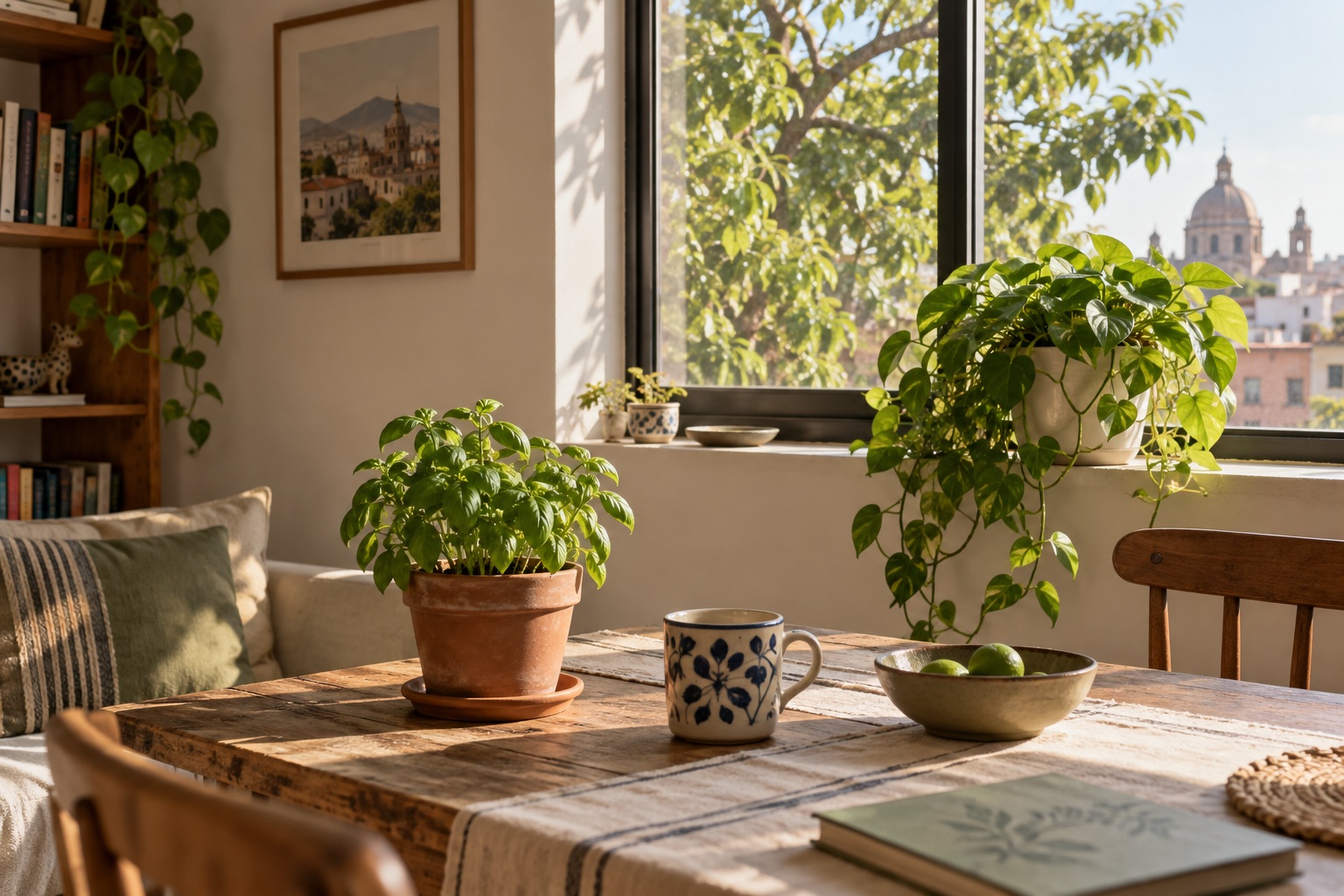
Some days we move from bed to desk and from desk to another screen without looking at the sky. On those days, a window overlooking a tree, a plant growing in the kitchen or a few minutes in the yard can change how we experience daily life. Biophilia gives a name to this search for closeness to living things. It also invites us to ask how to make room for them at home, even in a small apartment.
What is biophilia?
Broadly, biophilia means an affinity for life and living things. Biologist Edward O. Wilson popularized the idea in his 1984 book Biophilia. He proposed that people have an inclination to take an interest in other forms of life and in natural processes [1]. It is a hypothesis about our relationship with the living world; it does not mean everyone enjoys the same plants or that a houseplant can cure an illness.
At home, the idea is simple: create opportunities to see, care for and experience nature in your routine. That might mean a plant beside a window, daylight where you eat breakfast, herbs on a balcony or regular walks through a nearby park. Connection comes from what is inside the home as well as the chance to go out and notice the surroundings.
Why it may feel good
Green spaces offer chances to relax, walk, spend time with others and step away from some sources of noise and heat. A World Health Organization review describes ways urban parks and other green spaces may support physical and mental health [2]. These effects belong to the setting as a whole: movement, company, shade and rest may all play a part.
Inside the home, results are promising but less conclusive. A review of six observational studies found associations between having indoor plants and reporting less stress or fewer negative emotions. The authors also noted that evidence was limited and that several studies took place during the pandemic [3]. In an experiment with 60 students, a break near plants was linked to a small emotional improvement, but there was no significant improvement in working-memory recovery [4]. It is therefore reasonable to describe plants as a possible support for wellbeing, without promising the same result for everyone.
Another possible benefit comes from caring for a plant. Checking whether the soil needs water, cleaning a leaf or noticing a new shoot offers a concrete moment of attention. For some people, this is a pleasant break between tasks; for others, plant care is one more obligation. The experience depends on time, space and each person's relationship with gardening. Starting small helps you discover what you actually enjoy.
Walks complement what happens at home. In a study of adults in England, spending at least 120 minutes a week in nature was associated with better self-reported health and wellbeing than spending no time there [5]. This is an association. The study does not show that this amount produces the same outcome for everyone or prescribe a required dose. It can, however, inspire us to make time outdoors when our circumstances allow.
There is also an everyday benefit that needs no number: a home with natural elements can feel more personal. Choosing a plant you like, sharing cuttings or cooking with a herb you grew adds stories to a place. That emotional value is individual and can exist in a spacious home or on a small shelf.
Putting biophilia into practice
Observe your home before buying anything. When does daylight enter? Where can you see the sky or a tree? Where do you pause for a few minutes each day? Choose a spot already part of your routine, perhaps near the table, where you read or by the entrance. A plant is easier to enjoy and care for when you see it often.
If you want to begin with a pot, choose a species for the available light, your local conditions and the time you can give it. Ask for its scientific name and specific needs. Use a container with drainage and check moisture before watering: feeling the top layer of the growing mix usually tells you more than following a rigid calendar. Empty standing water from the saucer and watch for changes in the leaves. Horticultural extension advice likewise recommends adjusting light and water in response to each plant [6].
An accessible way to start is to grow something that fits into daily life. A culinary herb can connect plant care with cooking, provided it gets enough light. If you have room, a balcony planter lets you watch growth over several weeks. If light is limited, look for a species suited to that condition instead of putting a sun-loving plant in a dark corner. Seasonal flowers, seeds to sprout or a clear view outdoors can also help.
If you live with dogs or cats, check each species for toxicity before bringing it home. Golden pothos (Epipremnum aureum), for example, is toxic to both; the spider plant (Chlorophytum comosum) is listed as non-toxic in the ASPCA database [7]. Even with non-toxic species, it is sensible to discourage pets from chewing plants and to place pots securely.
You can also connect with nature without keeping pots. Eat breakfast for a few minutes by an open window when the weather and air quality permit. Pause to look at the shapes of clouds or listen to birds. Walk down a tree-lined street when possible, visit a park on the weekend or share the care of a small garden. If you have no garden, try noticing the plants along your regular route.
Try a two-week routine. For the first few days, identify a place at home you would like to enjoy more and spend a few minutes watching its light. Then choose one simple action: care for a plant, take a walk or sit near a window. Note what felt pleasant and what was hard to keep up. Adjust your routine accordingly. The goal is to fit the experience into your life, not to fill every room with green objects.
Set aside one common promise: a few houseplants do not “purify” a home's air by themselves. The US Environmental Protection Agency says there is no evidence that a reasonable number of plants removes significant amounts of pollutants from homes and offices [8]. To protect indoor air, address sources of pollution and ventilate appropriately for outdoor conditions. Plants have other value without being assigned a job they have not been shown to do at household scale.
A deeper look at biophilia
Biophilia also helps us think about our relationship with living things around us. From Wilson's proposal, an affinity for other forms of life may encourage an ethic of care [1]. At home, that idea takes a modest form: learning what a plant needs, accepting its rhythms and recognizing that they do not always match our own. We need not idealize nature to feel curiosity and responsibility toward it.
In environmental psychology, attention restoration theory, associated with Stephen Kaplan, proposes that some natural environments may offer a break from the effortful concentration we use to work or study [9]. Watching leaves move in the wind may hold our attention differently from solving a task. This is one possible explanation for why some people feel relief in a park or beside a green view; the theory does not guarantee that any plant will improve concentration.
We can turn that reflection into a personal question: what place do living things have in my days? For one person, it will be sowing and harvesting; for another, walking and recognizing neighborhood trees. Biophilia requires neither a particular aesthetic nor a plant collection. It invites an attentive relationship with the surroundings, built from repeated encounters that fit each home.
Beginning can be as simple as caring well for one pot or choosing a shaded walking route. Over time, such gestures help us know where we live and make room to notice it. That is a useful starting point for bringing nature into everyday life.
Sources consulted
Wilson, E. O. Biophilia (1984), Harvard University Press. JSTOR.
World Health Organization Regional Office for Europe. Urban green spaces and health (2016). WHO.
Zhao, T. et al. “When green enters a room: A scoping review of epidemiological studies on indoor plants and mental health” (2023). PubMed.
Archary, P. and Thatcher, A. “Affective and cognitive restoration: comparing the restorative role of indoor plants and guided meditation” (2022). PubMed.
White, M. P. et al. “Spending at least 120 minutes a week in nature is associated with good health and wellbeing” (2019). Scientific Reports.
University of Minnesota Extension. “Spring into houseplant care” (2026). University of Minnesota Extension.
ASPCA. Toxic and non-toxic plant profiles for dogs and cats: golden pothos and spider plant.
US Environmental Protection Agency. The Inside Story: A Guide to Indoor Air Quality. EPA.
Kaplan, S. “The restorative benefits of nature: Toward an integrative framework” (1995). DOI.